The story arrives in our inbox a few times a year, always the same shape. A business launches a beautiful new website. Within a month, organic traffic has halved, the phone has gone quiet, and nobody involved in the rebuild can explain why. The rankings that took years to earn evaporated in a fortnight.
It is a genuinely common outcome, and a completely avoidable one. Rankings are attached to specific URLs, specific content, and the structure connecting them. A redesign that changes all three without a preservation plan is, from Google's perspective, a brand new website wearing your domain. Here is the checklist that prevents it, the same one we run on every rebuild we take on.
Before the redesign: record what you are protecting
- Inventory every URL. Crawl the current site and export every page Google knows about from Search Console. You cannot preserve what you have not listed.
- Identify the earners. From Search Console and analytics, list the pages that actually receive organic traffic and rankings. On most small business sites, a dozen pages carry nearly all of it. These pages get special care.
- Record what those pages rank for. The queries attached to each earning page tell you what content must survive: the headings, the phrasing, the topics that earned the position.
- Note every backlink target. Links from other websites point at specific URLs. If those URLs die without redirects, the authority they pass dies with them.
During the build: the three preservation rules
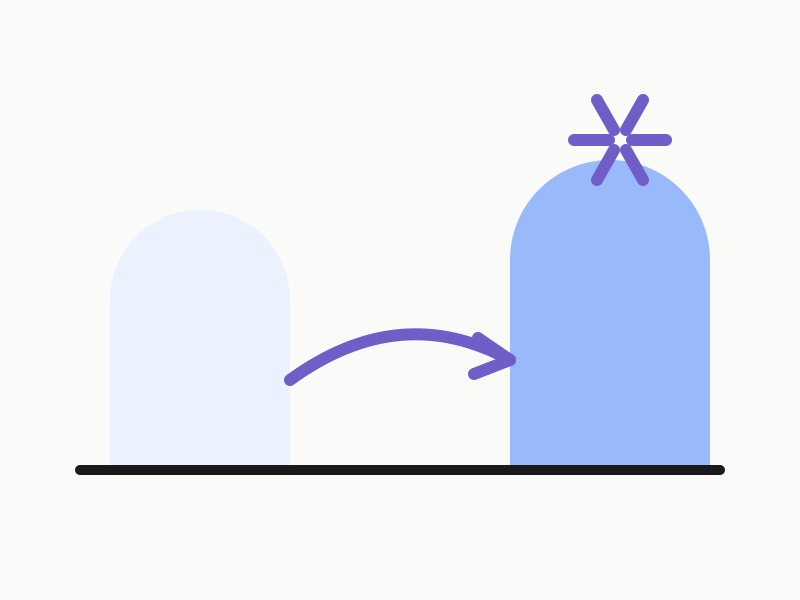
Rule one: keep URLs where you can, redirect where you cannot. The best redirect is no redirect; if a page's address can stay identical, keep it. Where the structure genuinely must change, every old URL gets a permanent 301 redirect to its closest new equivalent. Page by page, not everything to the home page: a blanket redirect to the home page throws away the specific relevance each old page held.
Rule two: preserve the content that earned the rankings. Redesigns love to trim copy for aesthetics, and copy is usually what was ranking. The safe pattern is to redesign the presentation around the substance: keep the topics, the headings that match real searches, and the depth, then improve the design and readability. You can absolutely rewrite for quality; just rewrite with the query data open in the next tab.
Rule three: carry over the invisible layer. Title tags, meta descriptions, heading structure, image alt text, internal links, and structured data all transfer or improve deliberately. Internal links deserve particular attention: the pages you link to most, and the words you use to link to them, tell Google what matters on your site.
Launch week: the technical pass
- Confirm the redirect map works: old URLs must return a single 301 hop to the right destination, not chains and not 404s.
- Check nothing shipped with a noindex tag or a blocking robots rule left over from the staging environment. This single leftover setting is behind a remarkable share of post-launch disasters.
- Submit an updated XML sitemap and request recrawls of the key pages in Search Console.
- Verify canonical tags point to the live URLs, not staging addresses.
- Confirm the new site is at least as fast as the old one. A prettier but heavier site trades away a ranking signal, as we covered in the real cost of a slow website.
After launch: watch the right dials
Some fluctuation in the first weeks is normal while Google recrawls. What you are watching for in Search Console is specific: 404 errors appearing (a missed redirect), impressions collapsing for a page that used to earn (content that lost its query match), or indexing warnings. Caught in week one, each of these is a small fix. Discovered in month three, they are an expensive recovery project.
A redesign done this way is not just safe; it is usually the single best SEO opportunity a business gets, because you are fixing years of accumulated structure and content decisions in one project. That is exactly how we treat it, and if a rebuild is on your horizon, talk to us before URLs get decided. That conversation is much cheaper early.